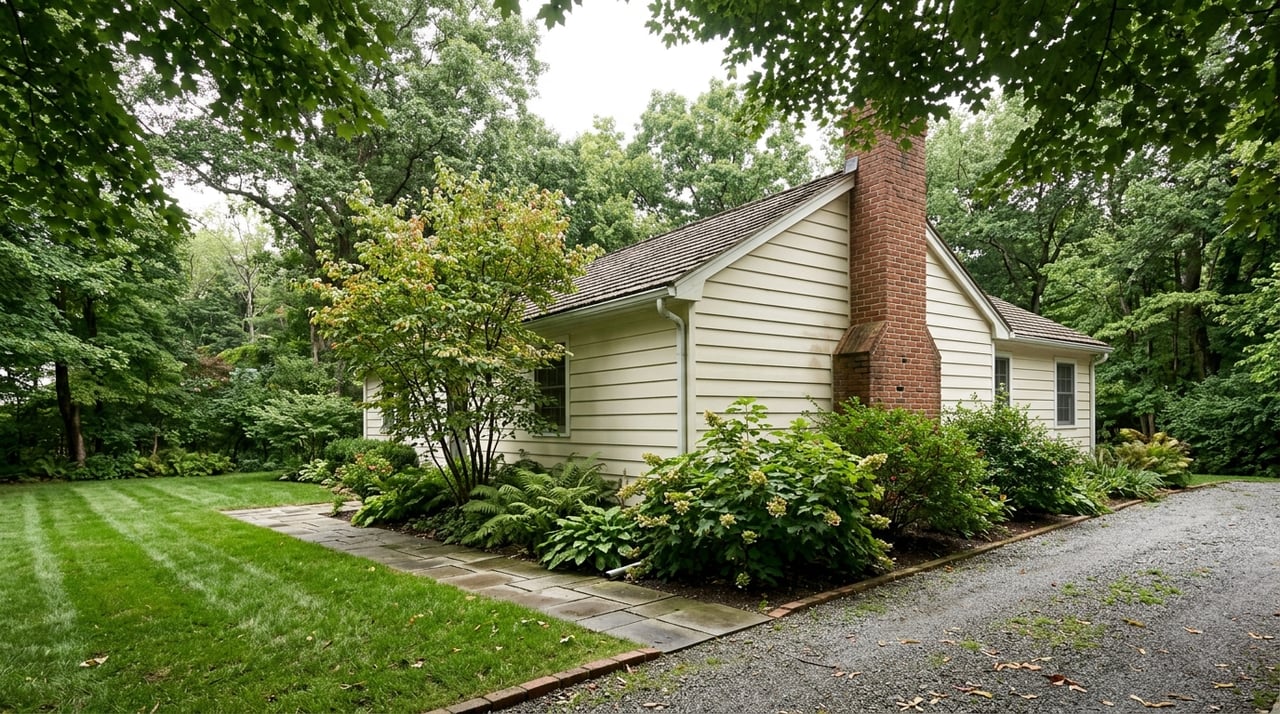
The question usually surfaces in September, after the offer is accepted and before the closing. A buyer who has just committed to a house three blocks off Lake Maxinkuckee asks where the boat goes next summer.
The honest answer is that nobody knows yet. The Town of Culver's pier spaces sold out for the 2026 season, the waitlist is open only to people who already own property in Culver and Union Township, and there are more than a hundred names on it. The town's own parks page says the wait "can take up to years for a boat slip space." The waitlist carries over from season to season, so you do not reapply, you simply wait.
That is the shape of the whole Culver market in one detail. The purchase price is set by the house. The annual cost of owning it, and much of what you can actually do with it, is set by two administrative statuses that never appear on a listing sheet: what kind of lake access is legally attached to the parcel, and how the county classifies the property once you own it. Two houses at the same price on the same street can carry very different answers to both.
Lake access is a legal status, not a distance
Buyers comparing Culver against Plymouth or Bremen tend to price the lake as proximity. Closer is worth more, farther is worth less. That is not how the water works here.
Indiana's Lakes Preservation Act governs what may be placed in the water at a public freshwater lake, which means what you can put in front of a Lake Maxinkuckee property depends on the rights that run with the deed. There are three practical tiers, and they carry different costs and different risks.
| Access tier | What the deed gives you | What goes in the water | What to verify before closing |
|---|---|---|---|
| Riparian frontage | Ownership bounded by the lake | A qualifying temporary pier under the state's general license, no DNR application required | Depth at your frontage, clearance from the neighbors' riparian lines |
| Deeded or association access | An easement or membership interest in a shared access point | A group pier, which requires a written DNR license, not a general license | The recorded easement text, the association's license status, annual dues |
| In-town or rural, public access only | Nothing beyond what any resident has | Whatever you can launch or rent | Town pier waitlist position, marina slip availability |
The general license is the reason frontage is worth what it is worth. A riparian owner can place a temporary pier without filing anything, provided it does not infringe the adjacent owner's access, is not unusually long or wide for that stretch of shoreline, and does not extend more than 150 feet from shore. Where the water runs continuously deeper than six feet past the 75 foot mark, the qualifying length drops to 75 feet. Indiana's DNR publishes the conditions in plain language, and it is worth reading before you assume a pier that was there last summer was there lawfully.
Group piers are the tier that catches people. Shared piers serving back lots and easement communities need a written license from the DNR, conditioned on navigability, on clearance from neighboring riparian zones, and on not interfering with abutting owners' property rights. An easement that promises "lake access" in 1968 language does not tell you whether the pier serving it is licensed, how many boats it is licensed for, or where you sit in the association's rotation.
If none of the three tiers applies, the fallback is the town park and beach, the public fishing pier on the north shore, and Culver Marina at 3000 East Shore Drive, which handles slip rentals, storage, and boat and kayak rentals. The town park department also rents its amphitheater, gazebo, Beach Lodge conference room, and both pavilions, including the farmers' market pavilion by the train depot. That is a real amenity set. It is not a pier.
One more detail from the town's rules that shifts a budget: slip agreements are seasonal only, there are no short-term rentals, and renters supply their own lift, personal watercraft included.
The second number, and why 2026 widened the gap
Indiana caps property tax bills as a percentage of gross assessed value, and the tier depends on use. An owner-occupied homestead is capped at 1 percent. Other residential property, which the state defines to include second homes, is capped at 2 percent. The cap is measured against gross assessed value, before deductions, which the Department of Local Government Finance walks through in its tax bill explainer.
That gap has always existed. What changed this year is that the state stacked new relief on top of it, and all of it lands on one side.
Beginning with 2026 bills, every qualifying homestead receives an automatic credit of 10 percent of the bill, capped at $300, applied by the county auditor with no application. Qualifying seniors can stack another $150, and disabled veterans up to $400. At the same time, the supplemental homestead deduction rose to 40 percent for 2026 and is scheduled to climb toward 66.7 percent by 2031 while the standard deduction phases down. Purdue Extension has tracked the phase-in schedule year by year.
Run that against a Culver purchase. A primary residence gets the lower cap, the deductions, and the new credit. The identical house bought as a weekend place gets none of the three. Same purchase price, same assessment, different annual carrying cost, permanently.
Culver already sits at the top of the county on this measure. Current Marshall County parcel records put Culver's median home price at roughly $254,800, its median effective tax rate at 0.98 percent, and its median annual tax bill at about $2,295, against a countywide median bill closer to $1,309 and a low of $535 in Lapaz. Culver's premium shows up twice, once in the price and again every year in the bill. A buyer trading a Plymouth house for a Culver house should model both columns, not one.
A related trap runs the other direction. If a property stops being your primary residence, whether you move, convert it to a rental, or restructure ownership, Indiana requires notifying the county auditor within 60 days. Skipping that step exposes the owner to the back taxes plus a civil penalty equal to 10 percent of them. In a town where properties rotate between full-time, seasonal, and rental use, that is not a theoretical rule.
None of this is tax advice, and no article should be your source of record on a specific parcel. The Marshall County Auditor and Assessor have the actual figures, and your own tax professional should confirm how the classification applies to you.
The calendar detail that catches autumn closings
Marshall County's fall installment is due November 10, 2026. Payment runs through the Treasurer's Office at 112 W. Jefferson, Room 206, in Plymouth, and pre-deadline check payments are accepted starting Monday, October 26 at Everwise locations, First Farmers Bank and Trust in Culver, and the Bremen and Bourbon clerk offices. The county posts the full schedule.
If you are closing a Culver purchase between now and then, that date drives proration and the initial escrow deposit. Assessment notices go out around mid-April, and the appeal window closes in June, which means the bill you inherit was set long before you signed anything.
Why access tiers are showing up as days on market
Statewide, the Indiana Association of REALTORS® reported in its market update for the week of August 3, 2026 that sales are up about 2.5 percent year to date with rates averaging roughly 50 basis points below last year, and that the slowdown is concentrated in mispriced listings. Correctly priced homes still go under contract in about a week. The spread between the two has widened over the past year. In the broader 16-county central Indiana region, F.C. Tucker's July 2026 report showed inventory up 19.7 percent year over year, pended sales down 4.3 percent, and a median of 18 days on market, four days longer than a year earlier.
Here is what that means on this lake specifically. When buyers have options and sellers have to be right on price, the most common pricing error in Culver is not square footage. It is an access-tier mismatch: a home with easement access priced against comparables with riparian frontage and their own pier rights. Those listings sit. Buyers who understand the three tiers can spot the mismatch in either direction, which is as useful for a seller setting a number as it is for a buyer challenging one.
What is changing downtown, and who it favors
The old Culver theatre on Lakeshore Drive was demolished on July 6, 2026. The Maxinkuckee Performing Arts Theater Foundation, led by president Kurt Neubauer, has been working with the town since early this year and hired consultant Webb Management Services to run feasibility studies toward a larger performing arts venue on the site. WKVI covered the town council work session on the project in July. Separately, the town partnered with Downtown Strategies on a five-year action plan for downtown, with a stakeholder session held at the Culver-Union Township Public Library in April.
Both efforts point the same direction: more reasons to be here in February. That matters most to the buyer whose classification is going to read "primary residence," which is also the buyer the tax code now rewards. Culver's calendar already runs past the boating season with Fall Fest, the holiday weekend, and WinterFest, and Cafe Max Eatery & Tap downtown keeps dinner hours on Fridays and Saturdays.
Questions we get
Can I get on the town pier waitlist before I own here? No. The town is currently adding only Culver and Union Township property owners. Closing is what makes you eligible, and the list carries over year to year once you are on it.
Does a shared pier mean I can keep a boat there? Not automatically. Group piers require a written DNR license, and the number of boats and the rotation are governed by that license and the association's own documents. Ask for both in writing during the inspection period.
Will the seller's tax bill be my tax bill? Often not. If the seller claimed a homestead and you will not, or the reverse, your cap tier, deductions, and eligibility for the 2026 credit all change. Ask the Marshall County Auditor how the parcel will be classified under your ownership.
If you are weighing a Culver purchase against something in Plymouth, Bremen, or elsewhere in Marshall County, the comparison worth making is not price to price. It is total annual cost to total annual cost, with the pier arrangement and the tax classification written down next to each other. We have been doing that math in this county since 1982, and we would rather do it with you before the offer than explain it after. Masterson & Associates can walk your specific parcel through both questions, or give you a current value picture if you are on the selling side. Schedule a free consultation.
